A solo CPA spent 11 hours every Monday during tax season just processing new client paperwork. Not doing tax work, processing intake forms, chasing missing documents, sending engagement letters, updating her Airtable tracker. Today that same process takes under 45 minutes of human attention per week. No custom software. No developer. Just off-the-shelf tools connected into one workflow. Per Harvard Business Review (Oldroyd, 2011; Drift update 2023), responding to inquiries within 5 minutes makes you 100x more likely to convert than waiting 30 minutes.
Why does manual client intake cost more than you think?
Manual intake isn’t slow, it’s a revenue leak. Every hour spent on paperwork is an hour not billed. Every delayed response is a prospect who’s already called your competitor. Speed is the single biggest lever in professional services conversion, and manual intake kills speed.
Per the HBR/Drift study cited above, firms that respond within 5 minutes are 100x more likely to convert than those waiting 30 minutes. Most professional services firms take 1-2 business days to respond to new inquiries. That 48-hour gap is where clients disappear.
The staffing math is worse. Per Statistics Canada’s 2024 Survey of Employment, Payrolls and Hours, the average Canadian employee costs $45,000 to $65,000 per year. If your admin staff spends 25% of their time on intake processing, that’s $11,000 to $16,000 annually on a process that’s 80% automatable. For a solo practitioner doing it themselves, every intake hour directly displaces billable revenue work.
What does an automated intake workflow actually look like?
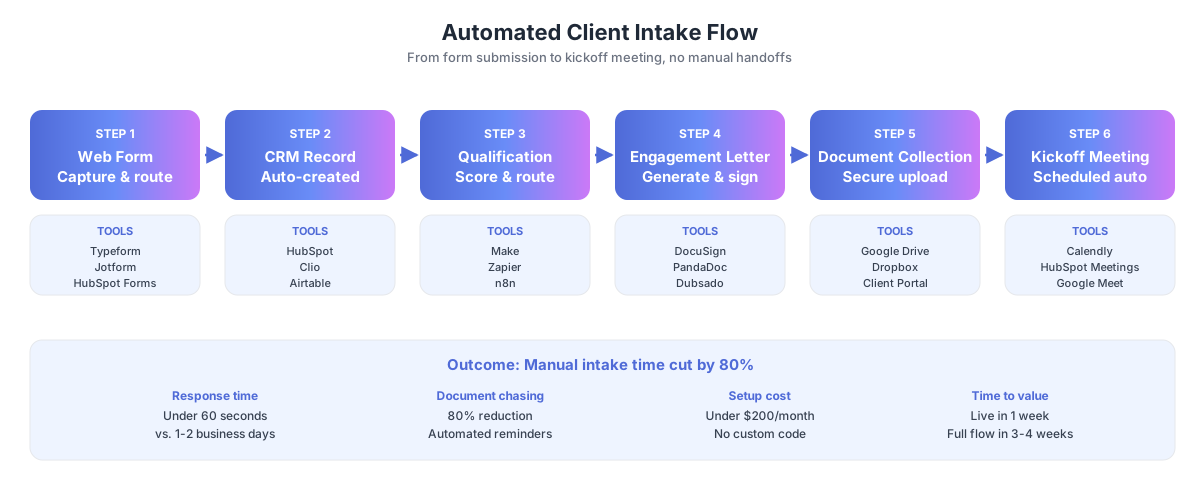
An automated intake flow captures leads through a smart form, creates a CRM record, scores qualification, sends an instant response, generates an engagement letter, collects documents, and schedules a kickoff meeting. Each step runs automatically using off-the-shelf tools connected through a workflow platform. No code required.
Here’s the full flow, step by step:
Step 1: Smart form captures and qualifies. A prospect fills out your intake form on Typeform, Jotform, or Dubsado. Conditional logic asks different questions based on service type. A personal injury case gets different questions than a corporate matter.
Step 2: CRM record created automatically. The form submission triggers a new contact in HubSpot, Clio, or Airtable. All fields map automatically. No copy-paste.
Step 3: Auto-qualification runs instantly. The workflow scores the lead against your ideal client profile. Qualified leads move forward. Unqualified leads get a polite redirect.
Step 4: Instant response goes out. Within 60 seconds, the prospect gets a personalized email with next steps and a calendar link. No human required.
Step 5: Engagement letter generated. For qualified prospects, DocuSign or PandaDoc auto-generates and sends the letter for signature.
Step 6: Document collection triggers. Signed letter fires off a document checklist with automated reminders at 48 hours and 5 days.
Per IDC’s 2023 Future of Work study, employees spend 30% of their time on manual data tasks. This flow recovers most of it.
How do I design an intake form that qualifies leads automatically?
Your form is the first filter. Good form design eliminates 80% of manual qualification. Build three sections: contact basics (required fields only), qualification questions with branching logic, and service selection. Keep it short, use conditional logic, and map every question to a downstream workflow decision before you build.
Build your form with three sections:
Contact basics. Name, email, phone, company. Required fields only. Every optional field reduces completion rates. Per Forrester’s 2024 Total Economic Impact studies, average ROI on business process automation is 200% in year one, but only if your entry point doesn’t create friction.
Qualification questions. These vary by industry. A law firm asks case type, timeline, and jurisdiction. An accounting firm asks entity type, revenue range, and filing deadlines. An immigration consultancy asks visa category, current status, and urgency. Design 3-5 branching questions so your automation can sort leads into categories.
Service selection. Let prospects self-select the service they need. This routes them to the right workflow and the right team member. Taxvisory uses Typeform conditional logic to route individual returns, corporate filings, and advisory requests down completely different paths. Each path triggers its own engagement letter template.
Which form builder should I pick?
Pick based on your industry. Typeform wins for conditional logic and prospect experience. Jotform leads for compliance-heavy industries like healthcare and legal. Dubsado combines forms with full client management for creative and consulting firms. HubSpot Forms is the pick if you’re already running HubSpot CRM.
| Tool | Best for | Pricing | Conditional logic |
|---|---|---|---|
| Typeform | Prospect experience | $25-$50/mo | Excellent |
| Jotform | Compliance, HIPAA | $34-$99/mo | Good |
| Dubsado | All-in-one client mgmt | $35-$40/mo | Good |
| HubSpot Forms | HubSpot CRM users | Free to $20/mo | Basic |
For a detailed walkthrough of HubSpot’s intake capabilities, see our best CRM for small business 2026 review.
How do I connect the form to my CRM without a developer?
Use a workflow connector: Zapier, Make, or n8n. These tools link form submissions to CRM record creation through point-and-click interfaces, no code required. Setup takes 15 minutes to 2 hours depending on complexity. For most professional services firms, Make offers the best balance of power and price under $30 per month.
Here’s how the three main workflow connectors compare for intake automation:
| Feature | Zapier | Make | n8n |
|---|---|---|---|
| Setup time | 15 min | 30-60 min | 1-2 hours |
| Best for | Simple 2-3 step flows | Complex branching | Technical teams |
| Integrations | 6,000+ apps | 1,500+ apps | 400+ apps |
| Pricing | $29-$99/mo | $10-$29/mo | Free (self-hosted) |
| Error handling | Basic retry | Advanced branching | Full control |
Make offers the best power-to-price ratio for most firms. Zapier wins on simplicity if your workflow is straightforward. n8n is the pick for firms with IT staff. We’ve built intake automations on all three. For a detailed comparison, see our Make vs Zapier small business guide.
The connection itself is straightforward: form submission triggers a “New Contact” action in your CRM. Map each form field to its CRM field. Add a duplicate check. Done.
How did Skylarks International automate immigration intake?
Skylarks International, a 15-person immigration consultancy, cut document collection time by 70% and status-update calls by 80% after automating their intake flow. The firm replaced manual data entry, email chasing, and phone check-ins with a single connected workflow built on Typeform, HubSpot, PandaDoc, and Make. Consultants now focus on case strategy instead of paperwork.
Before automation, prospective clients would call or email. A consultant would manually enter their info, request documents over email, then chase those documents for weeks. Status update calls alone consumed 30% of consultant time.
After mapping their process (the critical first step), they built this flow:
- Online form captures case details and visa category
- Auto-qualification determines if Skylarks handles this visa type
- Qualified prospects get instant response with Calendly booking link
- After consultation, PandaDoc generates the engagement letter
- Signed letter triggers document collection checklist with secure upload
- Automated reminders replace manual follow-up emails
- Client portal shows real-time status, eliminating phone check-ins
Per IDC’s 2023 Future of Work study, employees spend 30% of their time on manual data tasks. Skylarks cut that roughly in half for their intake team, recovering approximately $180,000 in consultant time annually across the 15-person firm.
What about engagement letter and document generation?
Engagement letters are a perfect automation target: they’re templated, required, and manually creating them is pure copy-paste work. DocuSign and PandaDoc dominate this space. Both pull client data from your CRM, generate the letter, route it for signature, and return the signed copy. Setup takes 1-2 hours per template and saves 10-15 minutes per client.
DocuSign handles the signature workflow with the deepest integration ecosystem. Templates pull client data from your CRM, generate the letter, send it for electronic signature, and route the signed copy back. DocuSign integrates directly with HubSpot, Salesforce, Clio, and most major CRMs. Per DocuSign’s 2024 Agreement Trends Report, organizations using electronic agreements close deals 82% faster than those using paper.
PandaDoc does the same thing with a stronger document creation interface. If your engagement letters need custom sections, pricing tables, or multi-party signatures, PandaDoc’s editor is more flexible. PandaDoc also connects with Stripe for automated payment collection on signing, useful for retainer-based firms.
Taxvisory uses Airtable for client tracking, TaxCycle for tax prep, and Calendly for scheduling. Their engagement letters auto-generate when a prospect’s status changes to “Qualified” in Airtable. The system pulls the client’s name, entity type, services selected, and fee schedule into the template. What used to take 15 minutes per client now takes zero human time.
What document collection workflow actually works?
The working pattern: signed engagement letter triggers a personalized document checklist, clients upload through a secure portal, automated reminders fire at 48 hours and 5 days for missing items only, and the team gets notified when the package is complete. This replaces manual email chasing and eliminates the “did you get my files?” phone calls that consume professional services teams.
Document chasing is the most universally hated task in professional services. Accountants chase tax documents. Lawyers chase evidence. Immigration consultants chase passports, transcripts, and employer letters.
The automated version works like this:
- Trigger: Signed engagement letter activates document request
- Checklist: Client receives a personalized list of required documents with a secure upload link
- Portal: Documents upload to a structured folder in Google Drive, Dropbox, or your practice management tool
- Reminders: Day 2, Day 5, and Day 10 reminders auto-send for missing items only
- Completion: When all items arrive, the team gets notified and the next phase begins
Taxvisory implemented this exact flow for 300 clients, cutting document chasing time by 80%. During tax season, that meant weekends off for the first time in years. For a deeper dive, see our how to automate document collection guide.
Per Gartner’s 2023 Data Quality report, poor data quality costs organizations an average of $12.9 million per year. Automated document collection doesn’t just save time, it improves data quality because clients upload directly instead of emailing files that get manually sorted and renamed.
How much does client intake automation cost?
A complete intake stack costs $150 to $350 per month for most professional services firms. That’s Typeform ($25), HubSpot Starter ($20), DocuSign ($15 per user), Make ($29), plus a document portal. Implementation costs range from $0 if you build it yourself to $3,000-$8,000 with expert help. Per Forrester 2024, average ROI on business process automation hits 200% in year one.
Here’s a realistic monthly cost breakdown for a 5-person firm:
| Tool | Purpose | Monthly cost |
|---|---|---|
| Typeform Plus | Intake form | $50 |
| HubSpot Starter | CRM | $20 |
| Make Core | Workflow connector | $29 |
| PandaDoc Business | Engagement letters | $65 |
| Calendly Teams | Scheduling | $80 |
| Google Workspace | Document portal | $72 |
| Total | $316/mo |
At $316 per month ($3,792 per year) against the $11,000-$16,000 in admin time a typical firm recovers, payback is under 4 months. Per McKinsey’s 2024 State of AI report, automation investments in professional services deliver measurable ROI within 6 months in 71% of cases.
How do I get started with intake automation this week?
Start with the single highest-impact piece: the instant response to new inquiries. One automation, form submission triggers immediate email with next steps, captures the 100x conversion advantage from HBR/Drift research. You can ship it in one week with Typeform, Zapier, and your existing email tool. Don’t try to automate everything at once.
Here’s your first-week plan:
- Day 1-2: Map your current intake process step by step on paper
- Day 3: Build your intake form in Typeform or Jotform with qualification questions
- Day 4: Connect the form to your CRM using Make or Zapier
- Day 5: Build the instant-response email template with Calendly link
- Day 6-7: Test end-to-end with 5 test submissions
Per Celonis’s 2024 Process Intelligence report, the median time-to-value for business process automation is 6 weeks. But the instant-response piece can go live in one week and deliver results immediately.
For the full intake automation including qualification, engagement letters, and document collection, plan for 3-4 weeks if building yourself, or 2 weeks with expert help. Our customer service solutions page shows how we’ve built these systems for professional services firms. You can also read the Taxvisory case study for a detailed look at how a solo CPA automated intake for 300 clients with no custom code.
Ready to automate your client intake?
The intake process is one of the few places where speed directly equals revenue. Every day you wait to automate it, prospects are choosing your faster competitors. If you want help mapping your current process and building the right stack, contact Builts AI for a free intake audit. We’ll review your current flow and show you exactly which steps to automate first.