Most small businesses pay for support twice: once in payroll and again in missed bookings after hours. If you are choosing between adding headcount or deploying AI agents, the decision comes down to fully loaded costs, per-ticket economics, and how much coverage your customers expect on nights and weekends.
Below is a clear cost comparison, practical math you can plug into your numbers, and industry examples for clinics, law firms, real estate, and home and local services in Toronto/Ontario and across North America.
The real costs of a human support team
Look past hourly wages to the full picture. In Ontario and North America, a single customer service rep’s annual cost typically includes:
- Base pay. Toronto: roughly CAD $20 - $28 per hour for experienced reps. Many U.S. markets: USD $18 - $25 per hour. Evenings and weekends push this higher with shift differentials and overtime.
- Benefits and payroll taxes. Health and dental plans, paid time off, CPP/EI or FICA, plus employer-paid insurance. Expect 20 - 30% on top of base pay.
- Tools and seats. Help desk or CRM ($20 - $60 per seat), VoIP/phone ($20 - $40 per seat), SMS and telephony usage, and reporting. Per-seat and per-minute fees grow linearly with headcount and volume.
- Training and onboarding. Shadowing, SOPs, QA, and manager time. New hires are often at partial productivity for weeks.
- Management overhead. Scheduling, QA, coaching, and performance reviews. Once you have several reps or extended hours, you need team leads and workforce management.
- Facilities and equipment. Laptop, headset, security, and a quiet workspace if in-office or hybrid.
Coverage is the multiplier. Business-hours-only teams are cheaper, but missed after-hours calls lead to lost bookings and annoyed customers. True 24/7 coverage requires multiple shifts and weekend staffing. Even if each rep is part-time, you need enough people to cover vacations, sick days, and spikes, which raises the effective cost of each always-on channel.
What AI agents cost and what they automate
AI customer service replaces a chunk of variable labor with setup plus ongoing service. The cost drivers are clear:
- Discovery and workflow design. Map SOPs, approval rules, disclaimers, and escalation paths. For small businesses, this often means formalizing tribal knowledge so AI can act without changing how your staff work.
- Integration and data access. Connect to the systems you already use. Builts.ai integrates with tools like Dentrix, Open Dental, Jane App, Eaglesoft, Cliniko, ServiceTitan, Housecall Pro, Jobber, and Google Calendar to read availability, create bookings, log notes, and send invoices. No migrations or retraining.
- Automation orchestration. We wire back-office flows using platforms such as n8n and Make, so actions like sending forms, generating estimates, updating statuses, or kicking off reminders happen reliably across apps.
- Capabilities tailored to your needs. Customer service across chat, email, and phone, booking and recall, lead capture and qualification, dispatch coordination, invoicing and collections, and follow-ups.
- Ongoing tuning and support. Monitor accuracy, refresh policies and prices, expand coverage as you introduce new services, and improve responses based on real conversations.
Unlike generic chatbots, an AI automation agency in Toronto or Ontario can design custom workflows that use your existing CRM, calendars, and spreadsheets. That lowers rollout risk, shortens time to value, and avoids asking staff to learn another tool.
Per-ticket math, bookings, and 24/7 coverage
Use a simple model to compare costs today with a hybrid setup.
Cost per ticket today. Cost per ticket = (average handle time in minutes ÷ 60) × fully loaded hourly cost.
- Email example: 7 minutes × $30/hour = $3.50 per ticket.
- Chat example: 4 minutes × $30/hour = $2.00 per ticket.
- Phone example: 8 minutes × $30/hour = $4.00 per call.
Those are conservative for routine questions. Complicated refunds, insurance questions, or intake calls take longer and drive the average up.
How AI changes the curve. Once configured, the marginal cost for additional chats, emails, or calls stays low. Our agents typically resolve 60 - 80% of routine tickets across channels. The human team then focuses on issues that need judgment, so each human minute is spent where it matters.
End-to-end actions reduce total cost per resolution. The biggest gains come when support can complete a task without a handoff:
- Bookings. Self-serve scheduling against real-time availability with instant confirmation. No back-and-forth.
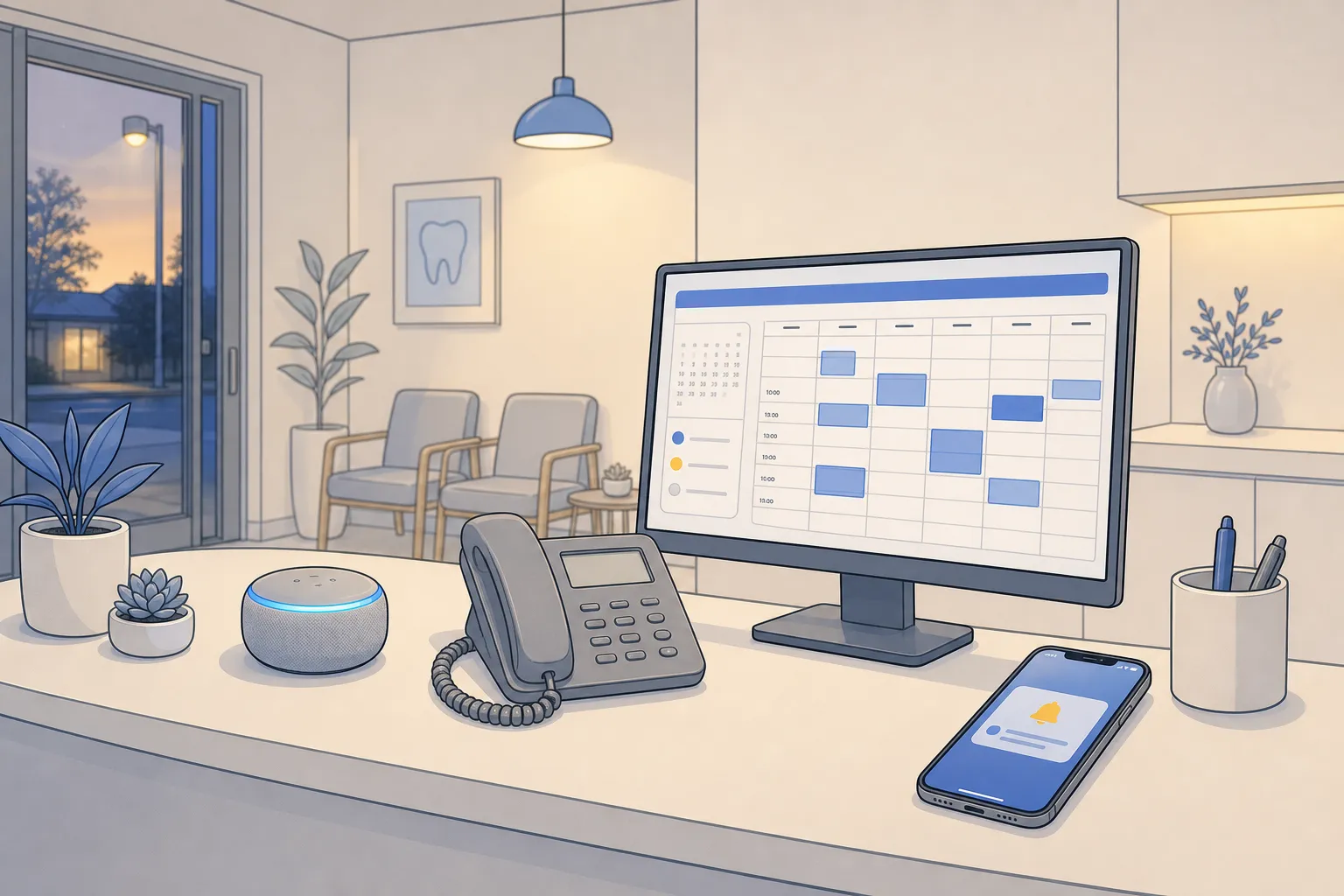
- Reminders and recalls. Multi-channel reminders at 7, 48, 24, and 2 hours lower no-shows and reopen cancelled slots to a waitlist. Dental clinics can run proactive hygiene recalls that offer live times and book automatically.
- Dispatch. For field services, check technician skills, location, and availability in ServiceTitan, Housecall Pro, or Jobber, assign the right tech, and confirm with the customer.
- Invoicing and collections. Generate invoices when the job completes and follow up with friendly reminders until paid.
Because the AI writes to the systems you already trust, data entry is automatic and consistent. Humans still handle sensitive matters, edge cases, and high-emotion conversations. The hybrid model assigns those to people while AI takes predictable flows and documentation.
If your team also monitors social channels, small helpers cut busywork. A tweet copier Chrome extension can pull an X.com post with text, media, author, and links into your clipboard so you can attach it to a ticket or internal notes without screenshots and manual copy-paste.
Break-even analysis for common small-business scenarios
Use this framework to decide if AI pays for itself:
- Baseline cost. Monthly tickets × average handle time × loaded hourly cost = current monthly support cost.
- Deflection rate. Estimate the share AI can resolve end to end. Many clinics, practices, and services see 60 - 80% of chats, emails, and routine calls fit repeatable patterns.
- Revenue actions. Add the value of bookings, recalls, dispatch, and invoicing the AI completes without a handoff. This is where cash flow improves.
- Ongoing spend. Add setup and monthly service for the AI agent. Subtract the human hours saved and the revenue protected by reminders and after-hours coverage.
Make it concrete with simple math you can adapt:
- Dental clinic in Toronto. 800 tickets per month across phone, email, and chat. Weighted average handle time: 6 minutes. Loaded hourly cost: CAD $34 (for example, $26 base + 30%). Current cost: 800 × 6 ÷ 60 × $34 = $2,720 per month. If AI resolves 70%, human tickets drop to 240, saving 560 × 6 ÷ 60 = 56 hours, or about $1,904 monthly. Add the impact of automated hygiene recalls and multi-channel reminders that keep the chair full, plus after-hours triage that filters true emergencies to on-call while handling routine questions. If your all-in AI cost is below the $1,904 saved, you are ahead before counting the extra booked hours.
- HVAC and home services. Summer spikes create missed after-hours calls. Suppose you currently miss 40 after-hours inquiries monthly and reach only a fraction the next day. With AI lead capture and dispatch coordination against ServiceTitan, Housecall Pro, or Jobber, inquiries are answered, jobs are scheduled to the right tech, and confirmations go out instantly. Your support cost per resolved request drops because there is no voicemail tag, and you protect jobs that would have slipped.
- Law and professional services. Intake calls and emails often ask the same questions. Voice AI can answer FAQs, collect intake details, and book consults 24/7 while routing conflicts or sensitive matters to staff. Billing automation handles invoicing and polite collections. Human hours shift to qualified matters, and response times improve for high-value clients.
Verdict. If your volume is low and every case is bespoke, a small human team may be enough. If you see repeatable questions, bookings, and after-hours demand, AI has a lower cost curve and better coverage. For most clinics, practices, brokerages, and local services in Toronto, Ontario, and across North America, a hybrid model is the sweet spot. Builts.ai agents typically deflect 60 - 80% of tickets, handle bookings, and trigger invoicing and follow-ups using your existing stack, so you lower per-ticket costs without buying new software.
Key takeaways
- Human support costs scale linearly with headcount, seats, and shift coverage.
- AI shifts spend to setup and tuning, keeping marginal cost per ticket low even at night and on weekends.
- End-to-end actions like scheduling, reminders, dispatch, and invoicing change economics more than replies alone.
- The best model is hybrid: AI for predictable flows and documentation, people for edge cases and sensitive conversations.
FAQ
What is the real cost of AI support for a small business?
You pay a setup fee and ongoing service for design, integrations, and tuning. The big savings come from deflecting routine tickets and automating bookings and invoicing.
How much of customer support can AI handle reliably?
For repeatable questions and workflows, 60 - 80% is common. Complex, emotional, or novel issues are better handled by humans in a hybrid model.
Can AI handle appointment scheduling and reminders?
Yes. Self-serve scheduling against real-time availability with multi-channel reminders reduces no-shows and fills cancellations from your waitlist.
Will I need to change my CRM or booking software to use AI?
No. An AI automation agency can connect to your existing tools like calendars, practice software, or field service apps so your staff do not need new systems.
How does AI support work after hours?
AI can answer common questions, capture and qualify leads, route emergencies, and even book visits by phone or chat, keeping you responsive overnight and on weekends.