

A marketing manager at a SaaS startup told us she spends three hours every Monday copying lead data from Google Sheets into HubSpot. Forty rows. Five fields each. Every single week. According to IDC’s 2023 Future of Work study, employees burn 30% of their time on manual data entry and transfer tasks. That’s a day and a half per week, gone. The fix isn’t complicated. It’s a one-time setup that runs forever. Here’s exactly how to build it, with three methods ranked by cost, complexity, and flexibility.
Why is copy-pasting between Sheets and CRM broken?
Manual data entry creates typos, duplicates, and stale records. Every transfer introduces formatting drift: a phone number becomes unusable, a dropdown value gets mistyped, a lead gets entered twice. The spreadsheet starts as a quick fix and ends up as the system nobody trusts.
The costs go beyond hours. Gartner’s 2023 Data Quality Market Guide reports poor data quality costs organizations an average of $12.9 million per year. Small teams feel the same pain at smaller scale: missed follow-ups, duplicate outreach, and “Hi {FirstName}” emails that damage credibility.
We’ve watched this pattern with dozens of clients. Someone builds a quick tracker in Sheets. Someone else starts entering leads there instead of the CRM. A month later, the CRM is outdated, the Sheet has conflicting versions, and nobody knows which source is right.
The deeper issue is that humans aren’t good at repetitive data tasks. Accuracy drops after the first hour. By row 40, mistakes are guaranteed. Automation doesn’t get tired.
What are the three ways to connect Sheets to a CRM?
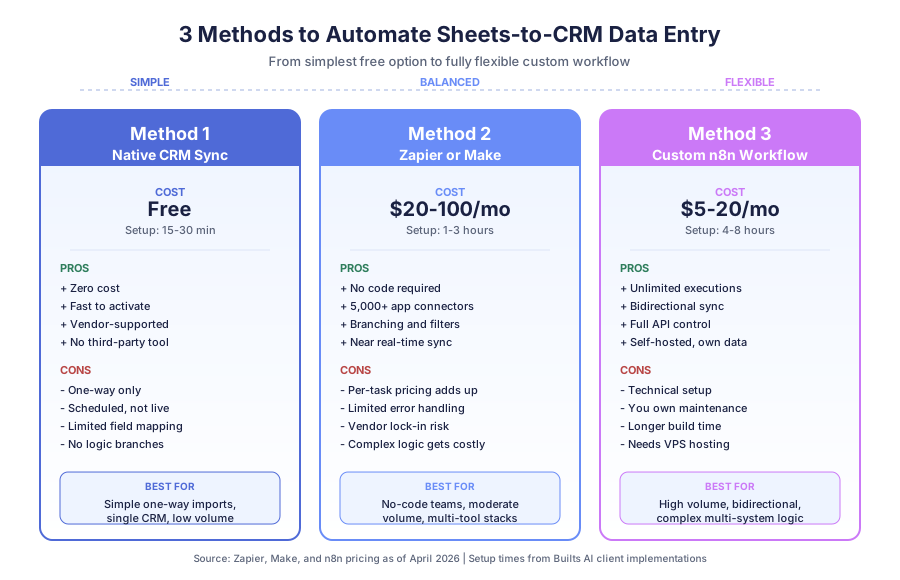
Three methods exist, ranked from simple to flexible: native integrations (free, limited), no-code platforms like Zapier or Make ($20-100/month), and custom workflows with n8n or direct API calls ($5-20/month hosting, unlimited logic). Your choice depends on volume, direction, and how many systems you need to connect.
Here’s the comparison:
| Method | Cost | Setup Time | Best For | Limitations |
|---|---|---|---|---|
| Native CRM integration | Free | 15-30 min | One-way imports | Limited fields, scheduled only, single direction |
| Zapier or Make | $20-100/mo | 1-3 hours | No-code teams, moderate volume | Per-task fees, limited error handling |
| n8n custom workflow | $5-20/mo hosting | 4-8 hours | High volume, bidirectional, complex logic | Technical setup required |
HubSpot’s native Google Sheets integration handles scheduled contact imports but won’t do real-time sync or bidirectional updates. Salesforce Data Import Wizard does batch loads but can’t watch a Sheet for new rows. If you’re still choosing a CRM to standardize on, our guide to the best CRM platforms for small businesses in 2026 compares HubSpot, Salesforce, Pipedrive, and Zoho side by side.
For most teams we work with, Make or Zapier hits the sweet spot. For clients like AcquireX Properties Capital, who needed complex deal data flowing between multiple systems, we built custom n8n workflows that handled volume and logic their 3-person team couldn’t manage through Zapier alone.
How do you set up a native Sheets-to-CRM sync?
Open your CRM’s integration marketplace, search for Google Sheets, authorize the Google connection, and map Sheet columns to CRM fields. Most native integrations take 15-30 minutes and handle basic one-way imports without any code. The tradeoff is limited flexibility.
For HubSpot: Go to Settings, Integrations, App Marketplace. Search “Google Sheets.” Connect your Google account. Choose the Sheet and tab. Map Column A to “First Name,” Column B to “Email,” and so on. Set the sync frequency (hourly is typical on free plans).
For Salesforce: Use Data Import Wizard under Setup. Upload a CSV export, or install a third-party connector like Coefficient or Dataloader.io for scheduled sync. Salesforce’s native tools are batch-oriented, not real-time, which rules them out for fast-moving pipelines.
For Pipedrive: The built-in spreadsheet import maps columns to Pipedrive fields. It’s a manual process each time, with no auto-sync. Pipedrive Marketplace has third-party apps like Coupler.io that add scheduled sync on top.
The limitation with every native method is the same: almost always one-way and scheduled. If your rep updates a deal stage in Pipedrive, that change won’t flow back to Sheets. For a strict one-directional pipeline where Sheets is the source and the CRM is the destination, native tools work fine.
How do you build a no-code sync with Zapier or Make?
Create a Zap (Zapier) or Scenario (Make) triggered by new rows in Google Sheets, then map each column to the matching CRM field and use a “create or update” action to avoid duplicates. A tested workflow takes 1-3 hours including field mapping, dedup logic, and a staging run.
Step-by-step with Zapier:
- Create a new Zap. Trigger: Google Sheets, “New Spreadsheet Row.”
- Select your Google account, spreadsheet, and worksheet.
- Action: Choose your CRM (HubSpot, Salesforce, Pipedrive).
- Pick “Create or Update Contact” so the Zap handles deduplication by default.
- Map fields: Column B (Email) to CRM Email, Column A (Name) to CRM First Name.
- Test with a real row. Verify the record appears correctly in your CRM.
- Turn on the Zap and monitor the history tab for the first week.
Step-by-step with Make: Make works similarly but offers stronger branching. Add a Router module after the Google Sheets trigger to send leads to different CRM pipelines based on a column value. For example, “Source = Website” routes to Pipeline A, “Source = Referral” routes to Pipeline B.
According to MuleSoft’s 2023 Connectivity Benchmark Report, the average enterprise runs 1,061 applications. Even small businesses connect 15-30 tools. Make’s multi-branch routing handles that complexity better than Zapier’s linear structure once workflows get serious.
Zapier starts at $19.99/month for 750 tasks. Make starts at $10.59/month for 10,000 operations. If you’re syncing more than a few hundred records monthly, Make is usually the cheaper pick. For a deeper breakdown of Make’s features and pricing tiers, see our Make.com review for 2026.
How do you build a bidirectional sync with n8n?
Install n8n (self-hosted or cloud), create a workflow with a Google Sheets trigger, add a CRM search node for deduplication, branch on match-or-create, and build a second workflow triggered by CRM webhooks that writes updates back to Sheets. Bidirectional sync is where most no-code tools break down.
When a rep updates a phone number in HubSpot, that change should flow back to Sheets. When someone corrects a company name in Sheets, HubSpot should update. No-code platforms struggle here because they assume one-way flow.
The n8n workflow structure:
- Trigger: Google Sheets node, polling every 5 minutes for new or updated rows.
- Lookup: HTTP Request node hitting the CRM API to search for existing records by email.
- Branch: IF node. Record exists? Update it. No match? Create it.
- Reverse flow: A second workflow triggered by CRM webhooks (HubSpot, Salesforce, and Pipedrive all support them) writing changes back to Sheets.
- Conflict resolution: Timestamp comparison. Whichever system was updated most recently wins the field.
We built this exact pattern for Pixorr, syncing data between Google Sheets, GA4, Semrush, Ahrefs, and Google Search Console. Their 5-person team reclaimed a full work week per month and saw reports generated 85% faster.
n8n is open-source. Self-hosting runs $5-20/month on a VPS. No per-task fees. For high-volume sync (thousands of records), the savings over Zapier or Make are substantial. The tradeoff is you own the maintenance, the upgrades, and the monitoring.
How do you handle duplicates and data conflicts?
Pick a unique identifier field (email is most reliable), configure your automation to search for existing records before creating anything new, and use upsert operations that update matches instead of duplicating them. Every sync workflow needs this logic on day one, no exceptions.
Duplicates are the silent killer of CRM data. You send two welcome emails. Your rep calls the same lead twice. Reports show inflated numbers. Per Gartner’s 2023 Data Quality Market Guide, poor data quality costs organizations $12.9 million per year on average. Deduplication is the single most important step in any sync.
The dedup checklist:
- Pick one primary key field (email for contacts, deal name plus company for deals)
- Search the CRM for existing records before every create operation
- Use upsert API endpoints when available (HubSpot and Salesforce both support this)
- Log every duplicate found for manual review later
- Run a monthly dedup audit using your CRM’s built-in merge tools
For field-level conflicts (“Toronto” vs “Toronto, ON”), establish a source-of-truth rule. In our experience, the CRM should win for fields reps update regularly (deal stage, notes, last contacted) and the Sheet should win for fields populated by forms or imports (lead source, campaign tag, UTM).
What are the most common field mapping problems?
Date formats, phone number formatting, dropdown values that don’t match between systems, and required fields empty in the source data. These four issues cause roughly 90% of sync failures in the workflows we build. Fix them in your automation logic, not by editing source data manually every time.
Here’s what breaks and how to fix it:
| Problem | Example | Fix |
|---|---|---|
| Date format mismatch | Sheet: “04/02/2026” vs CRM: “2026-04-02” | Add a formatting step (Zapier Formatter, Make Date module, n8n DateTime node) |
| Phone format | Sheet: “(555) 123-4567” vs CRM: “+15551234567” | Strip non-numeric characters, add country code prefix |
| Dropdown mismatch | Sheet: “Hot” vs CRM: “Qualified” | Build a lookup table mapping Sheet values to CRM picklist values |
| Missing required fields | CRM requires “Company” but Sheet cell is empty | Set a default (“Unknown”) or skip the record and flag for review |
Airtable deserves a mention here. Many teams use Airtable instead of Sheets, and it has field types (linked records, attachments, multi-select) that don’t map cleanly to CRM fields. We’ve built Airtable-to-CRM automations for clients like Taxvisory, connecting TaxCycle, Airtable, and Calendly so a solo CPA could manage 300 clients with 80% less document chasing.
What should you automate first?
Start with a single, one-way sync from your most active Google Sheet to your primary CRM. Run it reliably for two weeks. Then add the reverse direction. Then add your second data source. Small wins compound. Trying to build a bidirectional, multi-system sync on day one is how projects die.
The sequence that works:
- Week 1: One-way sync, new Sheet rows to CRM contacts. Test with 20 real records.
- Week 2: Monitor for duplicates and field mapping errors. Fix them.
- Week 3: Add the reverse direction (CRM updates writing back to Sheets).
- Week 4: Add a second source (form submissions, ad leads, another Sheet).
According to Forrester’s 2024 Total Economic Impact studies, the average ROI on business process automation is 200% within the first year. That return comes from systems that run reliably, not from complex setups that break every other week.
We’ve built these integrations for teams ranging from solo operators to 15-person companies like Skylarks International, where 70% faster document generation and 80% fewer status calls came from getting the data flow right first.
Start simple. Make it bulletproof. Then expand. If you’d rather skip the trial-and-error phase, book a free consultation and we’ll scope the right method for your stack.