Cluely raised $5.3 million in April 2025 after a founder used it to cheat on a coding interview, got suspended from Columbia, then filmed the whole thing (TechCrunch, April 2025). That stunt made Cluely the most talked-about AI tool of the year — and the most misunderstood. Here’s what Cluely actually does, how it works, what it costs in 2026, and when it’s a fair tool to deploy versus when it crosses a clear line. If you’re evaluating real-time AI for sales coaching, support desks, or meeting prep, the answers come down to disclosure, context, and honest framing with your team.
What is Cluely and what does it actually do?
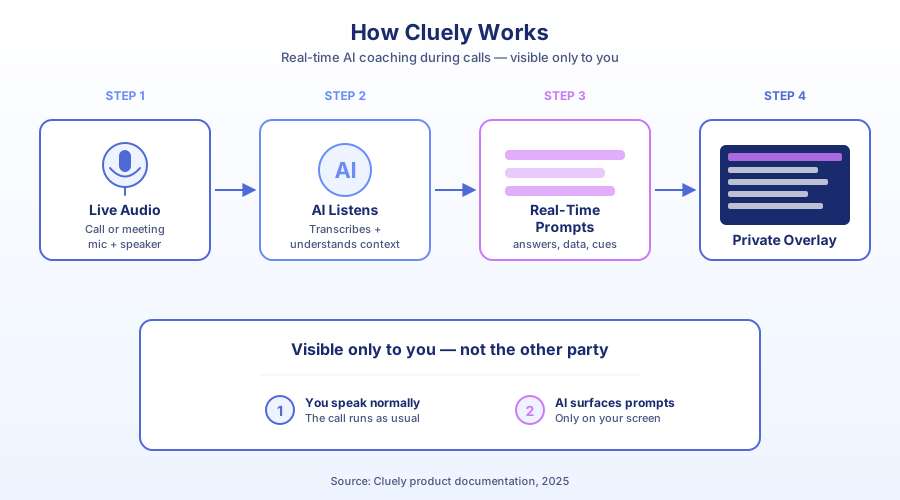
Cluely is a desktop AI assistant that listens to live conversations through your microphone and speaker, then displays suggested responses, product data, and contextual notes on a private screen overlay visible only to you. It’s designed for real-time coaching during calls, not post-call review like Fathom or Otter.
Depending on configuration, Cluely can show:
- Suggested answers to questions being asked in the moment
- Product specs, pricing, or policy details relevant to the discussion
- Objection-handling prompts triggered by specific customer concerns
- Running notes and key points from earlier in the conversation
- Background information about the person you’re speaking with
The other party sees your face, hears your voice, and watches whatever you explicitly share. They don’t see the overlay, the prompts, or the AI running on your machine.
How did Cluely start and why is it controversial?
Cluely began as Interview Coder in early 2025, built by Columbia University students Roy Lee and Neel Shanmugam specifically to help candidates cheat on LeetCode-style coding interviews. Columbia suspended both founders. They rebranded, raised $5.3 million, and relaunched as Cluely with a broader sales and support focus.
According to TechCrunch’s April 2025 launch coverage, the seed round was led by Abstract Ventures and Susa Ventures. Roy Lee filmed himself using Interview Coder in an Amazon interview, posted it publicly, and triggered the Columbia disciplinary action that became the company’s origin story.
The controversy matters because the technology is identical whether the use case is training a new rep or deceiving an interviewer. Cluely’s rebrand changed the marketing but not the underlying capability. Companies evaluating it need to think clearly about which side of that line their deployment sits on.
How does Cluely work technically?
Cluely runs as a local desktop application on macOS and Windows that captures system audio from your microphone and speakers, sends it to cloud-based large language models for real-time transcription and analysis, then renders suggestions on a semi-transparent overlay window. The overlay is excluded from screen-sharing by default.
The four-step flow is straightforward:
- Audio capture — Cluely listens through your system audio stack
- Transcription and context — AI converts speech to text and interprets intent
- Prompt generation — LLMs produce answers, data lookups, and coaching cues
- Private overlay — suggestions appear on screen, hidden from participants
Latency typically runs 1 to 3 seconds from spoken word to on-screen prompt, based on Cluely’s own product documentation published in 2025. That lag is short enough to feel useful but long enough that heavy reliance creates awkward pauses in conversation flow.
What are the legitimate business use cases for Cluely?
The strongest applications are disclosed internal coaching: new sales rep training, customer support agents handling complex products, and professional services consultants who need instant access to rate cards or regulations. In each case, Cluely replaces the role a senior colleague would play whispering guidance, which is standard practice in most call centers.
Sales rep coaching and onboarding
New sales reps typically take 3 to 6 months to reach full productivity, according to HubSpot’s 2024 Sales Enablement Report. Cluely compresses that curve by surfacing objection responses, product details, and competitive positioning in real time. The rep still drives the call. The AI just removes the “let me get back to you on that” friction.
This use case works when the team knows about the tool, the rep knows they’re being coached, and the customer is buying based on the rep’s actual judgment rather than a scripted AI performance. Disclosure to the customer isn’t required because senior reps listening to calls isn’t disclosed either.
Customer service and technical support
Support agents handling complex products benefit from real-time access to knowledge base articles, troubleshooting flows, and policy details. Gartner’s 2024 CX research found that 64% of customers care more about resolution speed than empathy when contacting support, which is exactly what live AI retrieval improves.
Cluely functions as a heads-up display for the knowledge base. Agents keep their eyes on the customer, and the AI handles the lookup work that would otherwise require alt-tabbing through 5 to 10 internal tools.
Professional services and consulting
Consultants, financial advisors, and technical engineers who reference detailed data during calls get the most value from real-time retrieval. Instead of saying “let me check and circle back,” they get the answer in the moment. That’s a meaningful competitive advantage in service businesses where responsiveness drives retention.
When is Cluely ethically problematic?
Cluely crosses the line when it’s used to misrepresent unaided capability in evaluative contexts: job interviews, professional certifications, high-stakes negotiations, or advice scenarios where the other party is paying for human judgment. The reputational damage from being caught in these contexts almost always outweighs the benefit Cluely provided.
The distinction is disclosure plus context appropriateness:
| Use case | Appropriate | Problematic |
|---|---|---|
| Internal rep training | Yes, with team awareness | Not applicable |
| Customer support | Yes, AI as knowledge base | Claiming deep expertise the agent lacks |
| Sales negotiations | Yes, for info retrieval | Closing deals on AI-scripted positions |
| Job interviews | Only if disclosed and allowed | Hidden use in any eval context |
| Professional advice | Yes, as reference tool | When client is paying for human judgment |
| Legal or medical consults | No, liability risk | Always problematic undisclosed |
A disclosed AI tool used for information retrieval is not meaningfully different from a search engine or CRM. A hidden AI tool used to simulate capability the user doesn’t have is deception, and in some contexts fraud.
How does Cluely compare to Fathom, Otter, and Fireflies?
Cluely is a real-time in-call assistant. Fathom, Otter, and Fireflies are post-call meeting recorders that transcribe, summarize, and extract action items after the conversation ends. They solve different problems and most teams running Cluely also run one of the recorders.
| Tool | Category | When it helps | Primary output |
|---|---|---|---|
| Cluely | Real-time overlay | During the call | Live prompts, answers, cues |
| Fathom | Meeting recorder | After the call | Transcript, summary, CRM sync |
| Otter.ai | Meeting recorder | After and during | Transcript, live captions |
| Fireflies | Meeting recorder | After the call | Transcript, analytics, search |
Otter has a live captioning feature that overlaps slightly with Cluely, but it shows a transcript rather than AI-generated coaching. For a full comparison of the recording tools, see our guide to Cluely vs Fathom vs Otter vs Fireflies.
How much does Cluely cost in 2026?
Cluely’s pricing in 2026 starts with a free tier offering limited daily usage, then scales through individual paid plans around $20 to $60 per month, team plans for businesses, and custom enterprise pricing, per Cluely’s published pricing page. Pricing has shifted multiple times since the April 2025 launch so always check cluely.com for current rates.
Typical tier structure as of early 2026:
- Free — limited sessions per day, basic prompts
- Pro individual — ~$20 to $60/month, unlimited sessions, advanced prompts
- Team — per-seat pricing, admin controls, shared prompt libraries
- Enterprise — custom pricing, SSO, security review, deployment support
For context, Otter Business runs $20 per user per month and Fathom Team runs $29 per user per month as of early 2026. Cluely is priced in the same range as the recorders, which makes running both tools a reasonable choice for most sales teams.
Should you use Cluely in your business?
Cluely is worth deploying when three conditions hold: the use case is disclosed or internal, your team is trained on appropriate use, and the conversations involve information retrieval rather than evaluative judgment. Sales coaching, customer support, and professional services all fit. Interviews, negotiations, and advisory calls usually don’t.
The practical bottom line is that Cluely is a powerful coaching tool wrapped in a notorious origin story. The technology is fair. The framing around “cheating” is the problem. If you set clear rules with your team about when and how it’s used, and you stay on the right side of disclosure, it’s one of the more effective AI productivity tools available in 2026. For a broader view of the AI tool landscape, see our guide to the best AI productivity tools for small business.
Book a free automation audit and we’ll map the AI tools — disclosed, reliable, and genuinely effective — that fit your team’s actual workflow and ethical standards.