A physiotherapy clinic serves 200 patients a month. Nearly every appointment ends well. The clinic has 23 Google reviews. Their competitor down the street has 340 reviews and a 4.8 rating with comparable service. The only difference: the competitor asks every patient for a review automatically, 3 hours after the appointment ends.
Review count isn’t a measure of service quality. It’s a measure of how consistently a business asks — and whether it asks at the right moment. BrightLocal’s 2025 Local Consumer Review Survey found that 76% of consumers who are asked to leave a review actually leave one, but only about 13% of small businesses ask consistently with a direct Google link. That’s where AI-powered review automation changes the math.
Why do businesses with great service have so few Google reviews?
Most service-quality-to-review-volume gaps trace to three causes: nobody asks consistently, the timing is wrong, and the ask is too vague. AI review automation fixes all three by triggering a personalized request 2-4 hours after a completed interaction with a one-click Google link — no staff reminders required.
Three specific failure points explain the gap:
1. Nobody asks consistently. Asking in person, in the moment, every time, is one more thing nobody remembers during busy periods. It feels awkward to some staff and varies by individual shift.
2. The timing is wrong. Customers are most likely to leave a review when the experience is fresh. A request that arrives three days later competes with everything else in their inbox.
3. The ask is too vague. “Feel free to leave us a review!” is easy to ignore. A direct link to your Google review page with one-click access removes every friction point.
BrightLocal’s 2025 Local Consumer Review Survey pegs consumer compliance at 76% when asked — meaning most businesses aren’t losing on willingness. They’re losing on consistency of the ask itself.
How does automated Google review collection work?
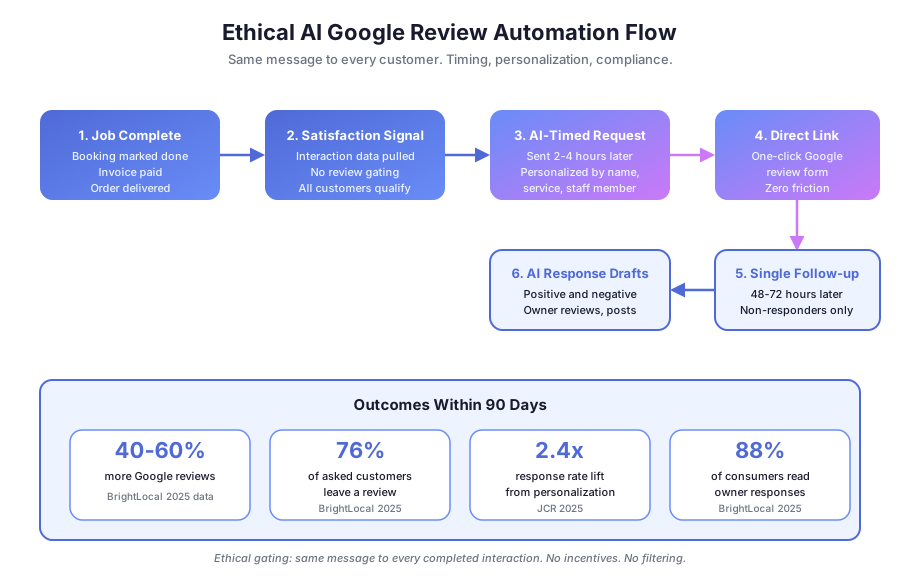
A trigger fires when an interaction completes, a personalized message sends 2-4 hours later with a direct Google review link, and a single follow-up goes to non-responders at 48-72 hours. That’s the entire mechanism. AI handles personalization and timing; the business handles service.
What events should trigger the review request?
Any signal that marks a successful interaction in your existing stack:
- Appointment marked complete in booking software (Jane App, Mindbody, Calendly)
- Project stage marked done in project management tool
- Invoice paid in accounting software (QuickBooks, Xero)
- Order marked delivered in your e-commerce platform
- Chat support ticket resolved with a positive outcome
- Contract signed or deliverable accepted in a CRM
Pick the signal that most reliably means “the customer just had a good experience.” For a salon, that’s appointment check-out. For an e-commerce brand, it’s delivery confirmation — not order placement. For a contractor, it’s project sign-off.
Why does the 2-4 hour window matter so much?
BrightLocal’s 2025 Local Review Research found that requests sent within 2-4 hours of a positive interaction generate roughly 3x the response rate of requests sent 24-72 hours later. The experience is fresh, the customer still has a positive feeling, and the request feels timely rather than intrusive. Wait a week and the customer has moved on.
How does AI improve the review request message itself?
AI personalizes at scale by pulling the customer’s name, service received, staff member, and outcome from your booking system, then generating a tailored message per interaction. A 2025 Journal of Consumer Research study on personalized feedback requests reported a 2.4x response rate over generic templates.
Compare the two:
Generic template: “Hi Maria, thank you for your visit today. We’d love your feedback on Google: [link].”
AI-personalized: “Hi Maria, thanks for coming in for your deep tissue massage with Jessica this afternoon. We hope you’re feeling great — if you have a moment, a Google review makes a real difference for our small clinic: [link].”
The personalized version references Maria’s name, the specific service, the exact staff member, and the emotional stake for the business. Every detail comes from the booking record automatically — no manual customization, no per-customer editing. At 200 appointments a month, that’s 200 personalized messages with zero marginal effort.
What should a business do about responding to reviews?
Responding matters more than most owners realize. BrightLocal’s 2025 Local Consumer Review Survey reports that 88% of consumers read owner responses before choosing a business, and 45% say a response to a negative review influences their choice. AI drafts both positive and negative responses in seconds — the owner edits and posts.
How do you respond to positive reviews without sounding generic?
Short, warm acknowledgment that thanks the reviewer and names something specific they mentioned. AI generates these from the review content in seconds. A three-line reply that references the customer’s actual experience — the stylist they mentioned, the dish they loved, the room they booked — feels human because it is human, even when AI drafted it first.
How do you respond to negative reviews without making things worse?
The blank page is the enemy. Most small business owners dread writing negative-review responses, so they delay for days or skip them entirely. AI reads the review, classifies the concern, and generates a response structure that acknowledges the issue, apologizes where appropriate, and offers a resolution path — without over-admitting fault.
The owner reviews, personalizes, and posts. Time from “dreading this response” to “response posted” drops from days to about 5 minutes. A calm, specific response to a 1-star review turns a negative into evidence of excellent customer service for every future visitor who reads the page.
What tools support AI-powered review management?
Options range from turnkey platforms for multi-location operators to custom Make.com automations for single-location shops. Choice depends on budget, number of locations, and whether you want a dashboard or a minimal under-the-hood flow. For most single-location SMBs, a custom automation offers the best cost-to-flexibility ratio.
| Tool | Best For | Monthly Cost |
|---|---|---|
| Birdeye | Full review management for multi-location SMBs | $299-399 |
| Podium | SMS-first collection for local service businesses | $289-449 |
| NiceJob | Turnkey review automation for solo and small teams | $75 |
| Make.com + SMS/Email | Custom automation connecting booking to review requests | $16-50 |
| GoHighLevel | All-in-one CRM with built-in review automation | $97-297 |
For most small businesses, a custom Make.com automation connecting your booking software (Jane App, Mindbody, Calendly) to SMS or email is the most cost-effective and customizable option. All-in-one platforms like GoHighLevel include built-in review automation — see our GoHighLevel review for how it compares. A turnkey platform like NiceJob makes sense if you want minimal setup and a managed dashboard.
What’s the ethical framework for automated review requests?
Send the same request to every customer after a completed interaction. No incentives. No filtering by predicted sentiment. Google’s policies allow automation; they explicitly prohibit review gating, paid reviews, and incentivized reviews. A compliant system is simpler to build than a non-compliant one — and it won’t get your Business Profile suspended.
What does Google explicitly allow?
- Sending automated review requests to all customers after an interaction
- Personalizing the request message with customer and service details
- Sending a single follow-up to non-responders
- Asking staff to invite customers verbally during or after service
- Including a direct link to your Google review form
What does Google explicitly prohibit?
- Incentivizing reviews (discounts, gifts, rewards, loyalty points)
- Review gating — filtering by predicted sentiment before sending
- Fake or purchased reviews from any source
- Asking employees, family, or vendors to leave reviews
- Bulk importing reviews from other platforms
Violators risk review removal and, in repeat cases, Business Profile suspension, per Google’s Contributed Content Policy updated in 2025. A legitimate automated system sends the identical ask to every completed interaction. Reviews from genuinely satisfied customers will dominate if your service is consistently good — which is exactly the point.
What results should a small business expect?
Most businesses see a 40-60% increase in monthly Google review volume within 90 days of going live, based on BrightLocal’s 2025 aggregated SMB data. The compounding effect is the bigger prize: more reviews lift local pack rankings, which drives more customers, who leave more reviews.
What does that look like in practice?
A chiropractor going from 4 reviews per month to 6 reviews per month adds 24 reviews annually. Over two years, that’s 48 reviews — enough to move from a single-digit count to a credible social proof baseline. A landscaper collecting 1-2 reviews per completed project instead of zero transforms from a 15-review profile to an 80-review profile inside a year.
The cost side is modest. A Make.com automation runs $16-50 per month. Setup takes 3-5 hours for a single-location business. Turnkey platforms run $75-449 per month with 1-2 day onboarding. For a service business where one new client is worth hundreds or thousands of dollars, payback typically happens inside the first 30 days.
For related reading, see our article on How to Automate Review Collection and Reputation Management and our guide on AI in Customer Service: What’s Actually Working in 2026.
Book a free automation audit and we’ll design a review collection automation specific to your interaction flow — connected to your existing booking or CRM system, timed for maximum response rate, personalized from your customer data, and fully compliant with Google’s review policies.