The new hire started on a Monday. By Wednesday, she still didn’t have a laptop. By Friday, she had the laptop but not the email access she needed to use it. She left after six weeks — not because the job was bad, but because the start had been chaotic enough to shake her confidence in the company’s competence. That story, or a version of it, had repeated three times in 18 months at a 45-person professional services firm. After automating onboarding, the firm cut time from 3 weeks to 3 days, lifted 90-day retention by 25%, and reduced HR admin time per hire by 80%. Here’s exactly what they changed.
What were the headline results of the onboarding automation?
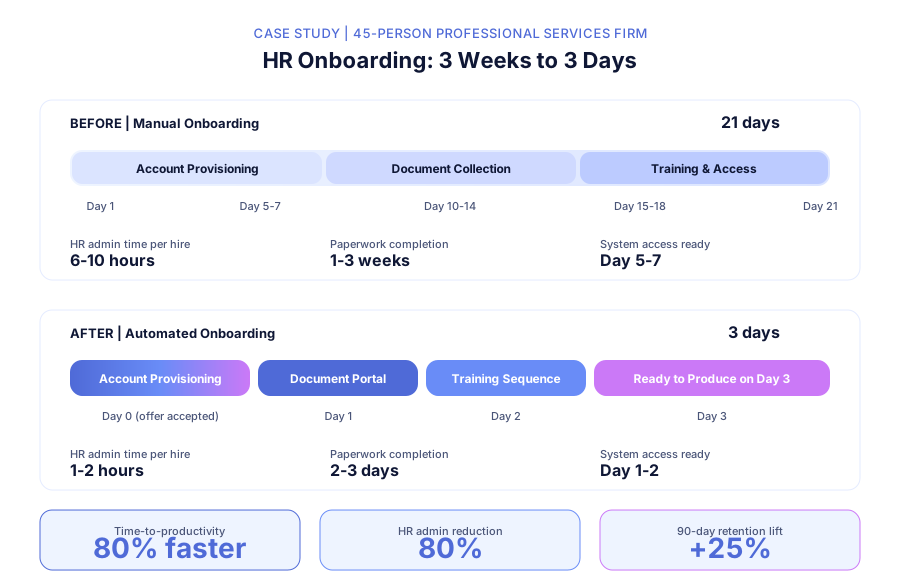
Answer capsule: The firm cut new hire onboarding from 3 weeks to 3 days, a 85% reduction in time-to-productivity. HR admin time per hire dropped from 6-10 hours to 1-2 hours of review. Paperwork completion compressed from 1-3 weeks of chasing to 2-3 days via a portal. 90-day retention improved 25% against baseline.
Here’s the 12-month tracking data from the firm’s HR team, comparing the old manual process against the automated workflow.
| Metric | Before | After | Change |
|---|---|---|---|
| Time to full system access | 5-7 business days | Day 1-2 | 80%+ faster |
| HR admin hours per hire | 6-10 hours | 1-2 hours | 80% reduction |
| Days to paperwork completion | 1-3 weeks | 2-3 days | 85% faster |
| 90-day retention rate | Baseline | +25% | Fewer early exits |
| Onboarding experience rating | Not tracked | Actively positive | Structured start |
Source: Internal HR metrics, 12-month post-implementation tracking, 2025.
The retention improvement is the most commercially significant number. Three early-stage departures per 18 months became one. Replacement cost savings in year one alone exceeded the automation system’s total cost.
What was actually happening during the 3-week onboarding window?
Answer capsule: The firm had a checklist but no system. HR manually emailed paperwork, forwarded IT provisioning requests, and tracked progress across scattered threads. System access took 5-7 days. Paperwork chasing took 1-3 weeks. Structured check-ins rarely happened. Each new hire received a different experience based on HR’s weekly workload.
In theory, the firm had an onboarding process. In practice, it was a document in a shared drive that relied on the HR manager remembering every item amid competing priorities.
Paperwork — employment agreements, tax forms, direct deposit, benefits enrollment — moved over email with no tracking. Documents arrived incomplete, unsigned, or not at all. HR chased each missing item individually.
Equipment provisioning required HR to manually notify IT, then follow up to confirm the laptop had been ordered and software licenses allocated. Each notification lived in an email thread that could be missed during a busy week.
System access — email, Slack, project management, CRM — was set up manually by IT after receiving the HR request. Average gap between start date and full access was 5-7 business days.
According to SHRM’s 2024 Human Capital Benchmarking report, organizations with structured onboarding improve new hire retention by 82% and productivity by over 70%. The firm had neither structure nor consistency.
What was the real cost of poor onboarding?
Answer capsule: Direct costs included $15,000-$25,000 per early-stage departure (recruitment, training, lost productivity) and 6-10 HR hours per hire. Indirect costs included paid idle time for new hires waiting on equipment, team disruption, and reputational damage on Glassdoor. Three early departures in 18 months cost the firm $45,000-$75,000 before accounting for morale impact.
According to SHRM’s 2024 Talent Acquisition Benchmarking report, average cost-per-hire is $4,683 excluding salary. For professional roles at the firm, the all-in cost of replacing someone who left in the first 90 days ran $15,000-$25,000.
Three early-stage departures in 18 months represented $45,000-$75,000 in direct replacement costs, before team disruption and morale impact.
The less visible cost was productivity loss for hires who stayed but started badly. A new hire who spends their first week waiting for equipment and their second week chasing access isn’t building relationships or producing value. That idle period is paid time with zero output.
According to Deloitte’s 2023 Global Human Capital Trends report, 83% of HR leaders cite onboarding experience as critical to long-term engagement. The firm had significant room to improve on a metric that directly affected retention and productivity.
What automated onboarding system did they build?
Answer capsule: The firm built a single integrated workflow that triggers on start-date confirmation. It handles pre-start document collection via a secure portal, automatic equipment provisioning to IT, system access setup, day-1 to day-5 training sequencing, and automated 30/60/90 check-in reminders. The human team focuses on welcomes, mentorship, and culture.
The system ties together four platforms: an HRIS (BambooHR) as the trigger source, a document portal with e-signature, a workflow engine (Zapier), and IT provisioning hooks (Okta). Total monthly tooling cost runs roughly $250.
The pre-start phase: offer to day 1
Answer capsule: The moment a start date is confirmed, the workflow activates. The new hire receives a welcome email with a secure document portal link. Equipment provisioning fires automatically to IT. Calendar invites for day 1 send. A pre-boarding message goes out 3 days before start with parking, first-day contacts, and week-one schedule.
Here’s the sequence:
- Offer accepted: Welcome email with secure document portal link
- Portal collects: Employment agreement (e-signature), tax forms, direct deposit, benefits choices, background check ID — all in one session
- Reminders: Automatic nudges at day 3 and day 5 for outstanding items
- Equipment trigger: Laptop, access card, software licenses fire to IT with role and start date — no manual handoff
- Calendar invites: Day 1 orientation, first-week manager meetings, team introductions auto-schedule
- Pre-boarding message: Sends 3 days before start with logistics and week-one schedule
New hires arrive on day 1 with paperwork complete, equipment ready, and the first week structured.
The first week: day 1 to day 5
Answer capsule: Day 1 through day 5 follows a consistent sequence. Welcome message sends automatically on day 1. System access is tracked against a completion checklist. Unresolved access triggers IT escalation on day 2. Training resources deliver across the week. The manager gets an automatic check-in prompt on day 3.
The automated sequence for week one:
- Team welcome message sends automatically day 1 morning
- System access (email, Slack, CRM, PM tools) tracked against completion checklist
- Outstanding access triggers automatic IT escalation on day 2
- Training schedule and resource links deliver via automated sequence
- Manager reminded automatically on day 3 to check in on the new hire’s experience
- Day 5 new hire survey captures early friction signals
The 30/60/90 check-in sequence
Answer capsule: Three structured check-ins now happen automatically. Day 30 focuses on role clarity and early friction. Day 60 focuses on team integration and support needs. Day 90 focuses on performance and retention signals. The check-ins happen in person — automation just ensures they happen, which was the original problem.
The check-in prompts include a structured question guide so HR walks into each conversation prepared. Any hire flagged as at-risk at 30 days carries that flag forward so the 60-day conversation is informed.
Research from Glassdoor shows structured onboarding improves productivity by 70% and retention by 82% — but only when check-ins actually happen. Manual scheduling was the breaking point. Automation removes it.
Why does onboarding quality affect retention this much?
Answer capsule: The first two weeks set lasting impressions about organizational competence. Research from the Wynhurst Group shows employees who go through structured onboarding are 58% more likely to stay three years. New hires who experience disorganization start questioning their choice — and that concern generalizes beyond onboarding into broader doubt about the company.
The firm’s new hires weren’t leaving because of pay, culture, or workload. They were leaving because their first experience of the company suggested operational disarray. That concern didn’t stay confined to HR processes. It colored how they interpreted every subsequent friction point.
According to Gallup’s 2024 State of the Global Workplace report, employees who strongly agree their onboarding was exceptional are 2.6 times more likely to be extremely satisfied in their role. Automated onboarding doesn’t just save HR time. It sends a signal about organizational quality to every new hire, on their most formative days.
The firm’s 25% retention improvement came from removing friction that was actively damaging confidence. Nothing about the role changed. Only the start changed.
What three principles make onboarding automation work?
Answer capsule: First, the first impression is set before day 1, so pre-boarding communication matters as much as day-one experience. Second, equipment and access provisioning cannot depend on manual notifications because every handoff is a delay risk. Third, structured check-ins improve retention regardless of what’s discussed — the fact that they happen is the signal.
1. The first impression is set before day 1. Pre-boarding communication — what to expect, what’s prepared, who to ask for — shapes confidence before arrival. Automation makes this consistent for every hire, not just the ones whose start date fell during a quiet HR week.
2. Equipment and access cannot depend on manual notifications. Every manual handoff between HR and IT is a potential delay. Automating provisioning triggers on start-date confirmation eliminates the most common source of “why don’t I have my laptop yet?” conversations.
3. Structured check-ins improve retention regardless of content. The fact that a 30-day check-in happens matters more than what’s discussed. A new hire who knows HR checks in at 30, 60, and 90 days feels supported. One who hears nothing until the annual review does not.
These three principles apply to any company past the point where informal onboarding works — typically around 25-30 employees, where the HR manager can no longer hold every hire’s context in their head.
Could this pattern work for your company?
Answer capsule: Yes, if you have a defined hiring cadence and at least 15-20 hires per year. The pattern works across professional services, technology, healthcare, manufacturing, and retail. Specific document requirements and access workflows differ by industry, but the structural approach — portal, provisioning trigger, structured check-ins — is consistent. Typical implementation takes 4-6 weeks.
The firm’s tooling cost runs $250 per month. First-year savings from one avoided early departure ($15,000-$25,000) cover the system for 5-8 years. Recovered HR hours (160 per year at 40 hires) redirect toward strategic work.
For related reading, see our guides on how to automate employee onboarding and how to automate document collection from clients.
Book a free automation audit and we’ll map your current onboarding workflow and identify the specific steps where delays are costing you early retention.